

De Minaur AO 2026 – The fourth night of the 2026 Australian Open was a study in strategic adaptation and psychological endurance. As a cold Melbourne front brought rain that suspended play across the outer courts, the tournament transitioned into an indoor spectacle under the roofs of the main show courts. This environmental shift fundamentally altered ball speeds, favoring those who could grind out points over those relying on raw, outdoor power. While the night ended as a “washout” for most of the local contingent—with five Australians eliminated—the nation’s top seed provided a masterclass in tactical discipline to keep home hopes alive.
Strategic success in Grand Slam tennis often boils down to a player’s ability to maintain their blueprint under high-pressure environmental changes. For the home crowd, the evening was a rollercoaster of emotions. We witnessed a masterclass in defensive redirection from the No. 6 seed, contrasted sharply by a systemic breakdown in composure elsewhere on the grounds. As the field narrows, the data points to a growing gap between the “Demon’s” fortified mental approach and the erratic performances that plagued his compatriots during this brutal second-round phase.
Defensive Mastery: The De Minaur AO 2026 Counter-Punching Blueprint
From an analytical standpoint, the encounter between Alex de Minaur and Hamad Medjedovic was a classic clash of styles: the high-velocity “Bully Ball” of the Serbian against the elite movement of the Australian. Medjedovic dominated the early exchanges, using aggressive linear power to snatch the first set in a tiebreak. However, the tactical adjustment from de Minaur in the second set was surgical. He consciously deepened his average ball placement, effectively pushing the world No. 90 into uncomfortable court positions and forcing him to over-hit.
De Minaur essentially weaponized his opponent’s power. By absorbing Medjedovic’s 150km/h groundstrokes and redirecting them with precision, he induced a total of 44 unforced errors from the Serbian. The momentum swung decisively as the “Demon” improved his first-serve winning percentage to 76%, refusing to give his opponent any rhythm. This defensive shell was so effective that Medjedovic eventually wilted, unable to find the lines as de Minaur closed out the match with a dominant 6-2, 6-2, 6-1 run.
Tactical Performance Index: De Minaur vs. Medjedovic
| Performance Metric | Alex de Minaur (Tactical) | Hamad Medjedovic (Aggressor) |
|---|---|---|
| Match Outcome | Won (6-7, 6-2, 6-2, 6-1) | Lost (7-6, 2-6, 2-6, 1-6) |
| Unforced Error Count | 18 | 44 |
| Break Point Efficiency | 55% (6/11) | 35% (6/17) |
| First Serve Percentage | 52% | 59% |
| Total Points Won | 114 | 82 |
Systemic Breakdown: The Jordan Thompson Foot Fault Argument
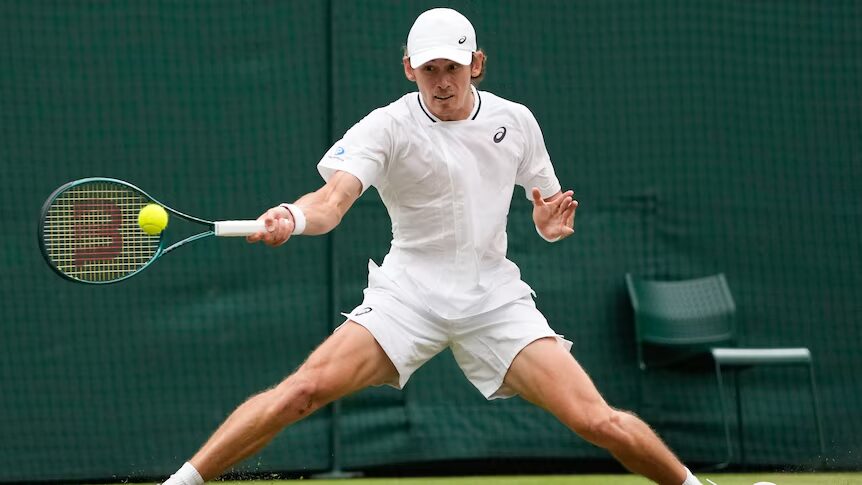
While de Minaur was clinical, Jordan Thompson’s match against Nuno Borges provided a case study in how officiating disputes can fracture a tactical plan. Thompson was initially locked in a tight battle, but his focus disintegrated following a series of electronic foot-fault calls on 1573 Arena. The resulting “moment of madness”—where Thompson publicly challenged the chair umpire over the reliability of the automated system—completely derailed his concentration.
The data supports this psychological tilt: Thompson’s first-serve reliability dropped significantly following the argument, allowing Borges to dictate play with his heavy baseline game. The veteran Aussie’s loss of composure led to a four-set exit (6-7, 6-3, 6-2, 6-4), marking a missed opportunity in a wide-open section of the draw. This exit was part of a broader “Aussie washout” that saw several locals fail to adjust to the pressure:
- Priscilla Hon: Blown off Rod Laver Arena by the 18-year-old prodigy Iva Jovic (6-1, 6-2).
- Ajla Tomljanovic: Suffered her seventh consecutive second-round exit at Melbourne Park.
- Cruz Hewitt: The doubles campaign ended in straight sets alongside James Duckworth.
The Lone Sentinel: Carrying the De Minaur AO 2026 National Project

With the elimination of his peers, Alex de Minaur is now the final Australian man standing in the singles draw. The weight of this national expectation was visible in the stands, where sporting icons like Cathy Freeman, Eddie Betts, and Rod Laver watched with intent. De Minaur has evolved from a fleet-footed retriever into a sophisticated counter-attacker, a transformation that has made him a “human brick wall” in the eyes of his opponents.
- Aerobic Efficiency: De Minaur covered less distance than Medjedovic (3.2km vs 4.1km), indicating superior point construction.
- Court Positioning: He moved his average return position closer to the baseline to take time away from the server.
- Mental Fortitude: Commentators John McEnroe and Jim Courier noted his refusal to “wilt” under the roof.
- Crowd Factor: The Rod Laver Arena crowd has become a secondary engine for the “Demon’s” high-intensity style.
Scouting the Blockbuster: Analyzing the Tiafoe Speed-Trap – De Minaur AO 2026

The third round presents a high-octane tactical puzzle: Frances Tiafoe. The American No. 29 seed enters the match with significant momentum after a four-set win over Francisco Comesana. Tiafoe plays with a flamboyant, high-risk style that contrasts sharply with de Minaur’s percentage-based game. This “speed-trap” match will require de Minaur to stay disciplined and avoid being drawn into the flashy, short-point shootouts that Tiafoe prefers.
Tiafoe is a momentum-based player who feeds off the crowd’s energy, but he has historically struggled against de Minaur’s relentless consistency. The “Demon” currently holds a 3-1 head-to-head edge, largely because he forces Tiafoe into hitting extra shots. If de Minaur can maintain his low unforced error count (currently averaging just 18 per match), he can likely frustrate the American into the same kind of “self-destruction” we saw from Medjedovic. However, the shadow of World No. 1 Carlos Alcaraz looms in the same quarter, making this a high-stakes crossroads for the Australian No. 1.
Conclusion: Can the Tactical Blueprint Hold Firm?
As the smoke clears from a chaotic Day 4, the tournament enters its most critical phase. Alex de Minaur’s belief in the “beauty of five-set matches” is not just a quote; it is his core competitive philosophy. He understands that his superior fitness and tactical maturity are designed for the deep waters of a Grand Slam. While the De Minaur AO 2026 campaign is now a solo mission for the Australian men, the No. 6 seed looks better equipped than ever to handle the burden.
The path to the second week is fraught with danger, particularly with a revitalized Tiafoe and a looming Alcaraz. Yet, the resilience shown under the roof on Wednesday night suggests that the “Demon” is operating at a different level of psychological fortification. As the Melbourne weather remains unpredictable, one thing is certain: de Minaur is the last sentinel guarding the host nation’s dreams, and he isn’t ready to let the wall crumble just yet.
About the Author


